You may have noticed that it's been a while since a new blog post appeared here. A big part of the reason is that we've started a Facebook page and have been actively posting there.
The Facebook format lends itself well to short blurbs with accompanying pictures, so we've been using it to show some of Video Voice's many capabilities and offer hints for using the games and displays effectively.
So come join us over there and see what we're talking about! If you don't already use Facebook, it's quick and easy to sign up (also free)! Once you've signed up, you can get to the page by typing "Video Voice Speech Training System" into the Search box (but you probably won't have to type more than "Video Voice" before a link pops up).
If you want to take a look right now, this will take you right there: https://www.facebook.com/pages/Video-Voice-Speech-Training-System/331641326140
Once there, you can easily review all the posts we've already made. Just scroll down and start reading from the bottom up
What we've been doing there is sowing seeds of new blog ideas, so keep checking back here, too!
Yours in good speech,
Video Voice Support Team
mv@videovoice.com
1-800-537-2182

Visual feedback that motivates and enhances the speech therapy process
Saturday, July 25, 2015


Tuesday, October 1, 2013
A Little Bit of Magic
 Whether for accurate production of a target by simply encouraging an autistic child to make a sound, a hearing-impaired child to produce a sound or word accurately, of a stutterer to achieve fluency in connected speech, Video Voice motivates and applauds the desired speech behavior with colorful, graphic animations and sounds. These reward graphics can be automatic in response to a therapist-defined goal, or manually activated by clicking the Reward button.
A while back, a husband and wife Behavioral Psychology consulting team visited our office to discuss how Video Voice might be helpful in their practice. They work with children on the low-functioning end of the autism spectrum. The wife, who is also a Speech-Language Pathologist, was well-acquainted with the power of Video Voice, having successfully used an earlier version (Apple IIe!!)
previously in a school setting. The husband wanted something more than a clickable Reward button, though. He wanted to be able to activate rewards himself, secretly. This would give him control over the reinforcement schedule, and let him "applaud" even minimal vocalization. In his words, he wanted a "remote clicker." The goal was for the child to associate vocalization with something fun on the screen, something he made happen by using his voice.
 In the release of Version 3.0.129, this idea came to fruition, and works anywhere you see a Reward button. Simply start the display, then slide the cursor down to any empty space on the red button bar at the bottom of the screen. Encourage the child to use his voice, and whenever you think he should be rewarded, right-click the mouse, and voila! A congratulatory message and/or reward animation or progress toward a game goal will happen. Magic!!
Hint: for a little more “magic,” remember that you can also customize the reward text and audios to personalize the experience for each child. See our earlier post on Personalizing Feedback for more details on modifying Video Voice audio and video rewards.
 You may find some individuals are motivated by the visual feedback alone - the colorful, changing displays in Pitch Painting and Kaleidoscope, movement of the train, car or horse in Chat-N-U-Go Choo-Choo, appearance of hidden pictures in Voice-A-Sketch, “eating up the dots” in Formant Gobble (Pac Man for speech!) mode. We've certainly heard from many therapists that their “kids” never want to quit trying!
In addition to animated graphic rewards, in some games and displays, performance at a therapist-defined goal reveals colorful congratulatory messages and sounds. The child seeing his name on the electronic billboard also makes those rewards especially effective.
We're always on the lookout for new ideas on how to improve Video Voice. Let us hear yours, too!
Yours in good speech,
Video Voice Support Team
mv@videovoice.com
1-800-537-2182
www.videovoice.com
Thursday, June 6, 2013
Why No Built-In Models?
We recently had someone ask why we don't have any samples of correct production of "default speech models" built into Video Voice. Well, there are several reasons why we decided to let the therapist or another speaker be in charge of providing the models of target words, sounds, and phrases in Video Voice, rather than doing it ourselves.
First of all, do you know how many words there are in the English language alone? According to the Global Language Monitor, there are now more than 1,000,000 words in the English language, and a new one is coined approximately every 98 minutes! To define and produce models for even 10% of them would be a daunting task!
A second reason is that we don't know what speech issues any given child (or adult) may have or what type of sounds or words that person needs to practice. Is it a small child who needs to learn basic production of sounds and simple words? Or is it a non-native speaker who needs to learn the difference between two similar sounds such as /e/ and /I/ (/e/ as in “sheet metal”) or the appropriate rate/timing in a phrase such as “mechanical engineer”? The target models and way to illustrate them is really up to the therapist to decide!
Third, there are significant dialectical differences across regions in this large country. "Normal" largely depends on where you happen to be located. A person from the northeast part of the country and a person in the south may pronounce the same word quite differently. Here's a link to a fascinating set of 22 national maps showing dialects' impact on speech that graphically illustrate some of these geographical differences.
Take, for example, a simple word like “Yes,” and how differently it can sound coming from the mouths of celebrities Katie Couric and Paula Deen. Katie would say “yEHs” while Paula’s vocalization would be more like “YAY-us.” Which is right and which is wrong? Really depends on where you are, doesn't it? This screen image shows how these two productions would look in Video Voice (the shorter "yEHs" is in blue, "YAY-us" in red.) Illustrating these kinds of differences makes the feedback effective for both accent reduction (ESL) or training (e.g., actors), as well as learning basic production of sounds.
Then there's the fact that people have different voice qualities. A man with a low-timbered voice and a woman with a higher-pitched voice would not tend to “score” well against each other's models, but their fundamental frequency differences will certainly be visible. If a woman needs to lower her speaking pitch, or a man raise his, that can be accomplished with the visual feedback in Video Voice.
Therapists can define the models themselves, or have a speaker of the same age and voice quality do the voicing of target sounds and words for individuals in their caseloads. If you're working with children, for example, perhaps having the “cool kid” in the class be the one to create models could be a good strategy. However, when the person receiving therapy does an accurate production of a desired sound/word, it's very easy, and desirable, to turn that production into the model. It's always easiest to match your own voice productions.
In conclusion, when looking at Video Voice for your speech needs, bear in mind that it is not a speech recognition program. It's a tool designed for training vocal production, one that illustrates sound and voice quality characteristics in various ways, offering an entertaining and motivating framework for learning, practicing, and improving speech skills.
Yours in good speech,
Video Voice Support Team
mv@videovoice.com
1-800-537-2182
First of all, do you know how many words there are in the English language alone? According to the Global Language Monitor, there are now more than 1,000,000 words in the English language, and a new one is coined approximately every 98 minutes! To define and produce models for even 10% of them would be a daunting task!
 |
| F2/F1 pattens for "bit" (red) and "beet" |
 |
| Temporal display - Mechanical engineer |
Third, there are significant dialectical differences across regions in this large country. "Normal" largely depends on where you happen to be located. A person from the northeast part of the country and a person in the south may pronounce the same word quite differently. Here's a link to a fascinating set of 22 national maps showing dialects' impact on speech that graphically illustrate some of these geographical differences.
 |
| Illustrating Dialectical Differences in "Yes |
Then there's the fact that people have different voice qualities. A man with a low-timbered voice and a woman with a higher-pitched voice would not tend to “score” well against each other's models, but their fundamental frequency differences will certainly be visible. If a woman needs to lower her speaking pitch, or a man raise his, that can be accomplished with the visual feedback in Video Voice.
Therapists can define the models themselves, or have a speaker of the same age and voice quality do the voicing of target sounds and words for individuals in their caseloads. If you're working with children, for example, perhaps having the “cool kid” in the class be the one to create models could be a good strategy. However, when the person receiving therapy does an accurate production of a desired sound/word, it's very easy, and desirable, to turn that production into the model. It's always easiest to match your own voice productions.
In conclusion, when looking at Video Voice for your speech needs, bear in mind that it is not a speech recognition program. It's a tool designed for training vocal production, one that illustrates sound and voice quality characteristics in various ways, offering an entertaining and motivating framework for learning, practicing, and improving speech skills.
Yours in good speech,
Video Voice Support Team
mv@videovoice.com
1-800-537-2182
Monday, April 29, 2013
What's New? Version 3.0.128 Has Launched!
Long time, no blog... Perhaps you thought we'd dropped off the face of the earth. Nothing could be farther from the truth. We've been busy for a number of months working on the recent release of Video Voice Version 3.0.128. Just when we were about ready to release it last fall, Microsoft threw us a bit of a curve ball with their own release of the new Windows 8 operating system. If you have tried it, you know that it's very different from earlier versions of Windows! Rather than release the new version with unknown compatibility, we spent the next several months making sure Video Voice will operate correctly on this new platform.
Now, FINALLY, we're happy to announce the release Version 3.0.128. In addition to Windows 8 compatibility and all its previous, fabulous features and capabilities, Video Voice 3.0 now includes:
Now, FINALLY, we're happy to announce the release Version 3.0.128. In addition to Windows 8 compatibility and all its previous, fabulous features and capabilities, Video Voice 3.0 now includes:
- Fundamental frequency measurement to complement other Assessment capabilities.
- Customization of on-screen reward text and other prompts to correspond with user-modified audios to personalize the therapy experience
- Enhanced trace operation in the Multi-Frequency Formant Spectral Display to make it easier to capture sounds for practice, opening up potential for work on minimal pairs, in addition to high frequency sounds and more
- Goal scoring in the Formant Multi-Frequency Gobble game to make display more effective for therapy use
- F2/F1 and Multi-Frequency (F3/F2) Gobble display access directly from Formant Menu to make reaching this powerful feedback mode easier.
- Simultaneous display of pitch and volume in P-A-R Connected Speech, with volume shown as peaks and pitch in spectrum colors
- New Streaming Speech P-A-R display, provides live, "marching" display of pitch, volume, or both volume and pitch (as color)
- New Fun & Games 12-Pack, a lower price option for those with limited budgets or interest only in game practice options
- Price reduction on all other software packages
- Revised internal documentation (Help) with more internal links to relevant pages
- Improved Windows 7 operation
There are numerous benefits to purchasing the Video Voice Speech Training System. The most important one is the change the displays and games bring to the therapy process - helping individuals feel more in charge of their speech skills. Another significant benefit is that software updates are FREE. As we add new features and capabilities, you may download and install a new copy at no additional cost.
Already an Authorized User? Please visit www.videovoice.com/vv_curel.htm to download Version 3.0.128 and update your Video Voice software.
Haven't yet made the investment in this valuable tool for your speech therapy activities? What are you waiting for? Download Video Voice 3.0 and try it for 30 days, with absolutely no charge, at www.videovoice.com/vv_demo.htm.
We'll be back soon to tell you more about some of these new capabilities and offer more thoughts on how visual feedback can accelerate the therapy process. Meanwhile, have questions? Need assistance with using Video Voice with your caseload? Want to restart a free trial you previously used to evaluate Video Voice's potential for your therapy needs? Just pick up the phone and give us a call, or send an email. We'd love to hear from you!
Yours in good speech,
Video Voice Support Team
1-800-537-2182
mv@videovoice.com
Friday, August 3, 2012
Have It Your Way
Video Voice is a very flexible speech tool, with options for nearly any kind of speech problem. Although the games and displays all have default settings, operation of most areas is up to you, and can easily be modified to fit your needs. To start with, there are no speech targets preprogrammed. It's up to you to define the content appropriate for the individuals in your caseload, and creating models is an easy process.
In addition, for almost any area of the program, there are ways to customize it to meet the needs of each and every individual in your caseload. Don't like some aspect of operation? Look around, there's probably a way to change it. Almost every control is adjustable!
So, how do you know when something can be modified? Well, Video Voice offers various visual cues.
- Any control that can be adjusted generally appears in cyan color.
- The mouse pointer offers hints, changing from an arrow to a hand when it passes over an adjustable control.
- If you briefly dwell the mouse cursor over a button or cyan control, a small “tool tip” will appear that briefly describes its operation.
Here are just some of the things you have control over:
 Speech Representation: With the Formant Displays, which are helpful for articulation, you can choose to represent sounds in a matrix or cross-time (temporal) form. Matrix generally illustrates sound differences more effectively than temporal displays, but does not show durational differences as well.
 With the P-A-R (Pitch-Amplitude-Rhythm) displays, you can view the pitch or volume characteristic of any sound production. With both Formant and P-A-R models, you can switch between the two styles with a single mouse click.
Formant Matrix Vowel Chart: By default, vowel symbols will appear on the screen in the F2/F1 matrix display, identifying the general locations on the screen where different vowels generally appear. Dont want to see them at all? Click the Vowels button to turn the whole chart off and on. The default vowel symbols are IPA style; if you prefer standard "dictionary" symbols in the chart, make that change with the Formant Adjust button.
Want to change the position of a vowel in the chart? Differences in speakers' production of vowel sounds can affect where they map on the screen. To change the position of any symbol, just click and drag it to the desired screen location. Don't want all the symbols to appear? Just click any symbol, drag it off the edge of the screen, and it will disappear. The new locations will be stored either in your therapist folder or in the individual's folder if one has been activated. This lets you customize the vowel chart to your own voice, or those of people in your caseload.
In the F2/F1 Gobble game, you can specify whether the vowels are "permanent," automatically refreshing when the Gobbler eats parts of them, or "erasable" and can be ''eaten up in the vocalizing process. This can be helpful if you're working on production of specific vowel sounds, and want the reward to be erasure of the symbols themselves. (Of course, the Gobbler's movement back to the corner of the voice space can cause parts of symbols to be erased without production of that sound, so use this cautiously!)
 Performance Goal: Typically set to 80 by default, this control exists in most displays and determines the score needed to achieve an “Excellent” message and see a reward animation. You can raise or lower it at any time to make the display or game more or less demanding. If you change the performance goal in one display, that change automatically carries over to the other displays, too.
Reward Animations: There are two types of reward graphics. One is an animated cartoon that appears on the right side of the screen in pattern-match displays. The other is a box in the middle of the screen that contains a congratulatory message along with a colorful pattern; these rewards appear in many of the games. You can preview and select among the animated cartoons with the Adjust button in the Formant and P-A-R displays.
The game rewards are controlled through the Game Preferences button on the Fun & Games menu. (There you can also choose from among the many reward sounds, too.)
You can control whether rewards appear automatically when a production's score exceeds your performance goal, override Video Voice if you disagree with its assessment, or award all cartoon animations yourself. Use the Formant and P-A-R Adjust buttons, or the Game Preferences button on the Fun & Games menu, to access these settings.
Game Controls: The Fun & Games options have a variety of adjustable controls. Some are common, shared across games, such as the Fade Speed (how fast a graphic disappears from the screen when the desired task isn't met) and Stop Sensitivity (how quickly Video Voice reacts to pauses in vocalization ). If you make a change to one of those common controls, it will apply to all games that have that adjustable option, too.
Mostly, however, controls are specific to the individual games. Examples:
Pitch Painting, which provides a colorful display of pitch, has adjustable brush shapes and sizes that let you add visual variety to the feedback. You can simply show varying pitch levels in speech, or choose only to reward vocalization with pitch above or below certain levels.
In Speech Ball, you can control how many balls will be in play in the game, the Speed at which they move, and the Hot Zone (area of the screen in which voicing will be detected).
With the Chat-N-U-Go Choo-Choo game, you can choose the game icon (antique or modern train, cars of different colors, or horse) and select from speech goals including more or less volume, vocal onset, or production of target sounds or individual words. Within any of the game goals, you have control over the performance required, speed of the game icon, and number or duration of vocalizations or trips required to complete the game, so you can make it easier or more demanding.
Likewise, Jumping Jack offers track events for work on volume control, duration, onsets and speaking rate. Each event has its own set of controls, such as running speed, vocalization time required, and amount of volume necessary for success.
The Bulls Eye! game lets you control which games appear in the menu. Although the little boys enjoy the bomb-dropping games and their explosions, some therapists prefer only the peaceable Care Packages and Flower Power games. With the Game Selection option, you can make the Battleships and Tanks A Lot games invisible and inaccessible. (This capability was added in response to a school district's non-violence requirement - we listen to our users!) You set the onset targets in all the Bulls Eye! games, and also can control the game speed.
The Voice-A-Sketch game has 78 built-in, high-quality pictures to choose from, but you can also use your own images if you wish. This makes it possible to tailor the graphic feedback to each individual's interests. Voice-A-Sketch also has multiple speech goal options, from simple continuous phonation or vocal onsets to volume control, duration, and word or sound articulation.

Personalized Audio and Display Text: Newly added to Video Voice is the ability to personalize the prompts for voicing and reward audios and messages that appear. The generic "Say" or "Very Good" messages can be replaced by "Mary, say..." or "Very good, Johnny!" Modified audios and text can be stored in each individual's case folder, customizing the feedback for each person you work with. In the International/Simplified Operating mode, the prompts can even appear in other, non-Latin keyboard languages such as Arabic.
These are just some of Video Voice's displays and games, and controls that let you "Have it your way." Look around and explore the software to determine what works for best for you and is most motivating and effective with members of your caseload! (If you don't already have Video Voice, download the program at www.videovoice.com and try it free for 30 days. If you're already using it, you can make sure you're using the most up-to-date version, and download a no-charge update there.)
Yours in good speech,
Video Voice Support Team
mv@videovoice.com
1-800-537-2182
www.videovoice.com
Thursday, February 23, 2012
Where R You?
Got any kids with 'R' problems in your caseload? Yeah, I thought so. From what we hear from speech-language pathologists, most everyone has at least one with that pesky and tough-to-correct speech issue. Video Voice has a number of games and displays that can help, and the one I'm currently excited about is the Formant Multi-Frequency Spectral Display included in the last release (V3.0.127). This new display uses live feedback to help speakers learn about production of 'R' (and other sounds, too). With it they can quickly learn how changes in articulator position make all the difference in what sound they're producing.
Off hand, I can't think of a single, commonly-used word that more simply defines the problem of 'R' and its oft-confused 'OO' than “were.” It's a pure combination of those two sounds, and producing it correctly requires subtle and largely invisible change in tongue position, or “bunching,” to move smoothly between them. The immediate feedback in the Spectral display can be powerful in illustrating when this is, or is not, happening, and it provides a facility for practicing and learning the differences in production of the two.
Let's take a closer look. Now, I'm going to assume that you have either purchased Video Voice or have downloaded the Free Trial (at www.videovoice.com) to explore what it offers for therapy, and do a little follow-along to give you some basis on how this display works. (And if you haven’t downloaded the trial, why not? There’s absolutely no charge or ongoing obligation!)
Start by accessing the Spectral Display from the Formant Menu (Multi-Frequency-Spectral).
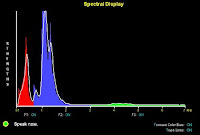 First, lets do some practice voicing. Click Start to activate the display, then vocalize. Say “were,” slowly, focusing on the F2 area in particular. You'll see very little blue when you're saying the 'woo' part of the word, but a great deal more when you hit (and sustain) the 'er'.
Also notice that as you speak, you see movement in all three Formant frequency ranges, and also a “trace” line above them. This is Video Voice averaging and smoothing the speech data into a single line as you speak, and it will be important as we go through this exercise.
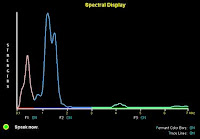 Say “were” slowly again, sustaining the 'r'. As you see the blue F2 region and associated trace line expand upward with that sound, click the Use button. Video Voice will draw and hold a light trace line showing what the frequencies in the F1, F2 and F3 regions were at the point where you captured the sound with Use. Now you have a “model” of the desired sound.
Now, try saying “were” again with the model trace on the screen. Say it slowly so you can see how the 'woo' and 'r' look, as well as the transition between the sounds. When you reach the 'r' part of the word, the blue F2 area should move up and touch the trace line.
Pretty darned cool, isn't it? It's a great way to practice sounds that are similar, but differ in important ways.
By the way, there's no scoring in this display, but you can always click the Reward button to activate a graphic animation when the speaker has reached the goal of producing that 'R' sound consistently.
And, if you find having all three frequencies shown at once confusing for this or any other sound, you can restrict the display and show only the most relevant one(s) by clicking the “ON” label(s) below the F1, F2 or F3 ranges. It will change to OFF, and you’ll no longer see that area of the display.
The live nature of this display makes it most useful for sounds that can be sustained, of course. In addition to 'R' and 'OO,' you'll also see big differences between sounds like ‘S’ and ‘SH,’ particularly in the F2 and F3 ranges. Give it a try!
We hope you have fun experimenting with this and other Video Voice displays and games to see how they can assist with your 'R' cases, as well as other speech problems in your caseload.
Yours in good speech,
Video Voice Support Team
mv@videovoice.com
1-800-537-2182
www.videovoice.com
Off hand, I can't think of a single, commonly-used word that more simply defines the problem of 'R' and its oft-confused 'OO' than “were.” It's a pure combination of those two sounds, and producing it correctly requires subtle and largely invisible change in tongue position, or “bunching,” to move smoothly between them. The immediate feedback in the Spectral display can be powerful in illustrating when this is, or is not, happening, and it provides a facility for practicing and learning the differences in production of the two.
Let's take a closer look. Now, I'm going to assume that you have either purchased Video Voice or have downloaded the Free Trial (at www.videovoice.com) to explore what it offers for therapy, and do a little follow-along to give you some basis on how this display works. (And if you haven’t downloaded the trial, why not? There’s absolutely no charge or ongoing obligation!)
Start by accessing the Spectral Display from the Formant Menu (Multi-Frequency-Spectral).
 First, lets do some practice voicing. Click Start to activate the display, then vocalize. Say “were,” slowly, focusing on the F2 area in particular. You'll see very little blue when you're saying the 'woo' part of the word, but a great deal more when you hit (and sustain) the 'er'.
The feedback is instantaneous! And, like speech, it's also fleeting. When you stop vocalizing, the visual disappears. So we need a way to freeze a target so the feedback becomes more concrete.
 Say “were” slowly again, sustaining the 'r'. As you see the blue F2 region and associated trace line expand upward with that sound, click the Use button. Video Voice will draw and hold a light trace line showing what the frequencies in the F1, F2 and F3 regions were at the point where you captured the sound with Use. Now you have a “model” of the desired sound.
Now, try saying “were” again with the model trace on the screen. Say it slowly so you can see how the 'woo' and 'r' look, as well as the transition between the sounds. When you reach the 'r' part of the word, the blue F2 area should move up and touch the trace line.
 |
| The 'oo' in "were" |
 |
| The 'r' in "were" |
Pretty darned cool, isn't it? It's a great way to practice sounds that are similar, but differ in important ways.
By the way, there's no scoring in this display, but you can always click the Reward button to activate a graphic animation when the speaker has reached the goal of producing that 'R' sound consistently.
And, if you find having all three frequencies shown at once confusing for this or any other sound, you can restrict the display and show only the most relevant one(s) by clicking the “ON” label(s) below the F1, F2 or F3 ranges. It will change to OFF, and you’ll no longer see that area of the display.
The live nature of this display makes it most useful for sounds that can be sustained, of course. In addition to 'R' and 'OO,' you'll also see big differences between sounds like ‘S’ and ‘SH,’ particularly in the F2 and F3 ranges. Give it a try!
We hope you have fun experimenting with this and other Video Voice displays and games to see how they can assist with your 'R' cases, as well as other speech problems in your caseload.
Yours in good speech,
Video Voice Support Team
mv@videovoice.com
1-800-537-2182
www.videovoice.com
Thursday, January 12, 2012
Personalizing Feedback
The latest release of Video Voice, Version 3.0.127, has a new feature sure to be popular among therapists and their caseloads. You now have the ability to personalize operation by recording your own audio prompts for voicing and congratulatory messages specific to those you work with.
The audio adjustment options are located in the Configuration Menu, with the Auditory Feedback button. From that sub-menu choose Record My Audios. However, to make it even easier to access that function, when you sign in with your Therapist ID, Video Voice checks to see if you've already customized any audios. If you haven't, it offers you the opportunity to do so. You can choose to do the recording immediately, asked to be prompted again later, or tell it to leave you alone and you'll do it when you're good and ready.
When you go to Record My Audios, you'll see the available pre-recorded audios. Click on one to select it, and Video Voice will play the audio for you. You can then record your own version for any or all, and save them for future use. After you make and save a recording the text turns blue to let you know it's been modified. (If you change your mind later, you can always revert to the defaults for the audios, or record new ones.)
Video Voice will automatically save any recordings you make in your Therapist folder, unless one of your caseload data files is active. In that case, it asks where you want to the recording: in your own folder or the individual's. This opens up the personalization options even further. Although the audio recording may be called "Speak now," the actual recording can be whatever you like. You could, for example, ask for a child's attention by using his name, e.g., "Jimmy, talk now!" Likewise, you can customize the reward audios with their names - "Wonderful work, Bobby!" You can have a different set of audios for each person - it's all up to you!
Therapists tell us that the kids they work enjoy about seeing their names on the screen in rewards, so having the computer talk directly to them as well adds even more excitement to the activities. (Note: If multiple therapists share Video Voice on a single computer, each one can have her own personalized sets of audios.)
There's also no reason the recordings have to be in English. Although the text for the prompts and rewards cannot currently be changed, the audio recording can be in any language. Video Voice doesn't know what language is being spoken, nor does it care. So, if you're using the program with speakers of other languages, you can modify the auditory feedback accordingly. (And watch for the ability to change text messages, too, in an upcoming release!)
By the way, this customizing option is available in the 30-Day Free Trial as well as the full Authorized User and International/Simplified operating modes. Give it a try for yourself by downloading at www.videovoice.com. Existing Version 3.0 users, you are entitled to the new and improved Video Voice via download, at no additional charge. To check which version you currently have installed, click on the telephone icon at the bottom of the Startup or Main Menu. If your version is lower than 3.0.127a, it's time to update!
Personalizing audios is just one of the ways you can customize Video Voice to satisfy your individual preferences. There are lots more, and we'll be talking about them in another post soon - stay tuned. Meanwhile, have fun making your own audio recordings and watching the smiles from your caseload when the computer calls them by name!
Yours in good speech,
Video Voice Support Team
mv@videovoice.com
1-800-537-2182
www.videovoice.com
Video Voice has two basic prompts for vocalization: "Say" (generally followed by the desired target) and "Speak now." There are also a number of reward and informational messages, such as "Excellent," "Good job," "Selected model is," "You said"). Pleasant, pre-recorded audios are included, but if you’d rather have your own voice providing these instructions and other feedback, you can easily customize them.
 |
| Click for a closer look |
 |
| Click for a closer look |
 |
| Click for a closer look |
Video Voice will automatically save any recordings you make in your Therapist folder, unless one of your caseload data files is active. In that case, it asks where you want to the recording: in your own folder or the individual's. This opens up the personalization options even further. Although the audio recording may be called "Speak now," the actual recording can be whatever you like. You could, for example, ask for a child's attention by using his name, e.g., "Jimmy, talk now!" Likewise, you can customize the reward audios with their names - "Wonderful work, Bobby!" You can have a different set of audios for each person - it's all up to you!
Therapists tell us that the kids they work enjoy about seeing their names on the screen in rewards, so having the computer talk directly to them as well adds even more excitement to the activities. (Note: If multiple therapists share Video Voice on a single computer, each one can have her own personalized sets of audios.)
There's also no reason the recordings have to be in English. Although the text for the prompts and rewards cannot currently be changed, the audio recording can be in any language. Video Voice doesn't know what language is being spoken, nor does it care. So, if you're using the program with speakers of other languages, you can modify the auditory feedback accordingly. (And watch for the ability to change text messages, too, in an upcoming release!)
By the way, this customizing option is available in the 30-Day Free Trial as well as the full Authorized User and International/Simplified operating modes. Give it a try for yourself by downloading at www.videovoice.com. Existing Version 3.0 users, you are entitled to the new and improved Video Voice via download, at no additional charge. To check which version you currently have installed, click on the telephone icon at the bottom of the Startup or Main Menu. If your version is lower than 3.0.127a, it's time to update!
Personalizing audios is just one of the ways you can customize Video Voice to satisfy your individual preferences. There are lots more, and we'll be talking about them in another post soon - stay tuned. Meanwhile, have fun making your own audio recordings and watching the smiles from your caseload when the computer calls them by name!
Yours in good speech,
Video Voice Support Team
mv@videovoice.com
1-800-537-2182
www.videovoice.com
Friday, November 11, 2011
More New Features, New Lower Price!
We haven’t posted recently. The reason is that we’ve been busy getting a new release of Video Voice out the door, and we’re pleased to report that Version 3.0.126 is now available for download at www.videovoice.com/vv_curel.htm.
This new version of the software has some great new features and capabilities, as well as numerous improvements to existing ones. And, Video Voice is now available at an even lower price! Here are some of the noteworthy changes and additions.
Formant Spectral Display
The immediate feedback in this display can be very helpful for work on ‘R’ vs ‘OO’ and discrimination of high frequency sounds like ‘S’ and ‘SH’. Give this one a try! (Formant Menu - F3/F2/F1 Multi-Frequency-Spectral) We’ll be back to talk more about using the Spectral display in an upcoming post, but for now we just wanted to let you know there have been some big changes in that display.
Customized Audio
Version 3.0.126 lets you personalize operation with your own audio recordings of voice prompts, congratulatory messages, and other vocal feedback. Your voice can be the one in prompts for voice production ("Say [target]") and reward messages, and they can be in whatever language you use or prefer. Explore this new capability through the Configuration Menu-Auditory-Feedback options.
New Voice Prompt
Video Voice now indicates readiness for voice input in many games and displays with the prompt "Speak now." This audio help the speaker know when Video Voice starts "listening," and it's time to turn his voice on. "Speak now" is one of the prompts that you can customize to your voice.
Localization and Keyboard Language Support
Video Voice has always been "language-independent," even though the user interface is in English. The displays and audio recording don’t know what language is being spoken, just that sound is present. Sound is sound, and all languages of have frequencies that can be visually interpreted. (Okay, maybe not "San," the clicking language used by some African tribes, but they’re not likely to be much interested in using computers for speech practice...) But speech work with Video Voice in other than English is certainly possible, and in fact the games and displays are being successfully used for speech development and remediation in many countries around the globe.
To support non-English use further, a few months back we introduced the International/Simplified operating mode. This streamlined mode will accept and display characters in all keyboard languages. (Authorized User and Free Trial support Latin-based keyboards only.) Want to show model names in prompts in Arabic, Greek, Cyrillic, Hebrew? No problem! However your keyboard is defined in Windows, Video Voice’s International/Simplified mode will handle it. This gives you the ability to display on-screen text such as user and model names, in the orthographics of your language. In this operating mode, however, data cannot be stored for reuse.
The International/Simplified mode also offers translations of buttons and controls on the therapy and game screens for Spanish and French languages.
The Authorized User and Free Trial modes do support non-English, Latin-based keyboards such as Spanish, French, Portuguese, German, Italian, etc. This means your model and user names can contain special, accented characters used in those languages.
Fluency Guide
For those people who work with fluency cases, there’s a new "Solutions" pdf document that offers suggestions on how to use the games and displays to reduce stuttering. (Find it on the Main Menu-Solutions-Fluency pdf)
Big Bad Bug Fix
Some users had reported a lock-up bug in some articulation games, particularly those that do model-matching. It was ugly, causing Video Voice to become unresponsive and require a restart. We’d seen the problem too, but just couldn’t reproduce it reliably. If you can’t make a failure happen in identifiable ways, it’s darned hard to fix. Kind of like when you take your car to the shop and report a strange noise, but of course it doesn’t make that noise so the mechanic can hear it! Anyway, we knew the problem was real, and battled it for several months, but believe we finally have it fixed. (I’m sure you’ll let us know if we haven’t, though!) We’ve made a number of other improvements in the articulation games, too.
New Lower Price!
In these hard economic times, things are tough all over, so we’re doing our part to make Video Voice even more affordable. We’ve reduced the price on all package configurations. To learn more, go to the Pricing page on our web site: www.videovoice.com/vv_price.htm
Why Download the Current Version?
If you’re already a Video Voice user, but haven’t downloaded a new copy of the software in a while, it’s really time to do that now, since there are many additions and major improvements! There’s no charge for software updates, so what are you waiting for?
If you’ve looked at Video Voice in the past, but didn’t make the decision to add this powerful tool to your speech therapy arsenal, it’s time to take another look! With the new games, displays and features to help you streamline your therapy results, it’s a shame not to give it another try. You may be able to start another Free Trial automatically, but if you need assistance with that, we’ll be happy to offer it.
We’ll be back soon with more details on some of these new features and some interesting stories, but for now, please check out this new version of Video Voice. Think you’ll like what you see!
Yours in good speech,
Video Voice Support Team
1-800-537-2182
mv@videovoice.com
www.videovoice.com
This new version of the software has some great new features and capabilities, as well as numerous improvements to existing ones. And, Video Voice is now available at an even lower price! Here are some of the noteworthy changes and additions.
Formant Spectral Display
 |
| Live F1/F2/F3 Spectral Display |
The Formant Multi-Frequency Spectral display provides live feedback on the F1, F2 and F3 frequencies in speech. Previously released in preliminary form, it has now been completely revamped. In addition to smoother display of data, you can now capture "traces" to use as models for sound practice.
The immediate feedback in this display can be very helpful for work on ‘R’ vs ‘OO’ and discrimination of high frequency sounds like ‘S’ and ‘SH’. Give this one a try! (Formant Menu - F3/F2/F1 Multi-Frequency-Spectral) We’ll be back to talk more about using the Spectral display in an upcoming post, but for now we just wanted to let you know there have been some big changes in that display.
Customized Audio
Version 3.0.126 lets you personalize operation with your own audio recordings of voice prompts, congratulatory messages, and other vocal feedback. Your voice can be the one in prompts for voice production ("Say [target]") and reward messages, and they can be in whatever language you use or prefer. Explore this new capability through the Configuration Menu-Auditory-Feedback options.
New Voice Prompt
Video Voice now indicates readiness for voice input in many games and displays with the prompt "Speak now." This audio help the speaker know when Video Voice starts "listening," and it's time to turn his voice on. "Speak now" is one of the prompts that you can customize to your voice.
Localization and Keyboard Language Support
Video Voice has always been "language-independent," even though the user interface is in English. The displays and audio recording don’t know what language is being spoken, just that sound is present. Sound is sound, and all languages of have frequencies that can be visually interpreted. (Okay, maybe not "San," the clicking language used by some African tribes, but they’re not likely to be much interested in using computers for speech practice...) But speech work with Video Voice in other than English is certainly possible, and in fact the games and displays are being successfully used for speech development and remediation in many countries around the globe.
To support non-English use further, a few months back we introduced the International/Simplified operating mode. This streamlined mode will accept and display characters in all keyboard languages. (Authorized User and Free Trial support Latin-based keyboards only.) Want to show model names in prompts in Arabic, Greek, Cyrillic, Hebrew? No problem! However your keyboard is defined in Windows, Video Voice’s International/Simplified mode will handle it. This gives you the ability to display on-screen text such as user and model names, in the orthographics of your language. In this operating mode, however, data cannot be stored for reuse.
The International/Simplified mode also offers translations of buttons and controls on the therapy and game screens for Spanish and French languages.
The Authorized User and Free Trial modes do support non-English, Latin-based keyboards such as Spanish, French, Portuguese, German, Italian, etc. This means your model and user names can contain special, accented characters used in those languages.
Fluency Guide
For those people who work with fluency cases, there’s a new "Solutions" pdf document that offers suggestions on how to use the games and displays to reduce stuttering. (Find it on the Main Menu-Solutions-Fluency pdf)
Big Bad Bug Fix
Some users had reported a lock-up bug in some articulation games, particularly those that do model-matching. It was ugly, causing Video Voice to become unresponsive and require a restart. We’d seen the problem too, but just couldn’t reproduce it reliably. If you can’t make a failure happen in identifiable ways, it’s darned hard to fix. Kind of like when you take your car to the shop and report a strange noise, but of course it doesn’t make that noise so the mechanic can hear it! Anyway, we knew the problem was real, and battled it for several months, but believe we finally have it fixed. (I’m sure you’ll let us know if we haven’t, though!) We’ve made a number of other improvements in the articulation games, too.
New Lower Price!
In these hard economic times, things are tough all over, so we’re doing our part to make Video Voice even more affordable. We’ve reduced the price on all package configurations. To learn more, go to the Pricing page on our web site: www.videovoice.com/vv_price.htm
Why Download the Current Version?
If you’re already a Video Voice user, but haven’t downloaded a new copy of the software in a while, it’s really time to do that now, since there are many additions and major improvements! There’s no charge for software updates, so what are you waiting for?
If you’ve looked at Video Voice in the past, but didn’t make the decision to add this powerful tool to your speech therapy arsenal, it’s time to take another look! With the new games, displays and features to help you streamline your therapy results, it’s a shame not to give it another try. You may be able to start another Free Trial automatically, but if you need assistance with that, we’ll be happy to offer it.
We’ll be back soon with more details on some of these new features and some interesting stories, but for now, please check out this new version of Video Voice. Think you’ll like what you see!
Yours in good speech,
Video Voice Support Team
1-800-537-2182
mv@videovoice.com
www.videovoice.com
Tuesday, August 23, 2011
Help!!
What do you do when you need help communicating information about speech with those in your caseload and getting them to understand how to make changes in their voices? The little boy who just can't seem to find the right tongue position for his 'R's. The girl whose slushy 'S' is driving you crazy. The youngster who just won't do purposeful voicing.
There are, of course, a plethora of speech therapy techniques and a number of tools available to streamline the process. One of those tools is the visual feedback on voice production Video Voice provides. We obviously believe its displays and games offer great benefits for communicating about most any aspect of speech development and remediation, and so do the many speech-language pathologists who have added it to their tool kits.
But what do you do when you need help with Video Voice? Used to be, you’d pull out the big user manual and pore through the index for answers. The problem with printed documentation, however, is that it can all too quickly become out of date, especially if the software changes. Since we’re always working on adding to and improving Video Voice, changes are a common and frequent occurrence. We therefore decided not to provide a printed manual, but instead make it an internal, integral part of the software operation. As the program changes, so does its reference material.
On virtually every Video Voice screen, you’ll find a Help button. Clicking it opens the built-in manual to the page appropriate to the area you're using. This internal documentation is not the anemic, sketchy variety many software programs have, the kind that can raise more questions than they answer. Video Voice's Help file contains more than 150 "pages" of information, chock-full of details on what the controls do for you, and how they function. The pages have an on-line "feel" to them, and are loaded with links that easily transport you to other related parts of the manual.
There are other built-in tools, too, like the Help Me Choose interactive guide and the Solutions and Support materials, all of which have buttons/links on the Main Menu. The "tool tips" for controls that appear when you dwell your cursor over them also briefly describe function to let you know if a control is what you need to use.
But sometimes you just really need to talk to somebody! We're proud to offer friendly, responsive support to both existing Video Voice users and those who are evaluating to see how it can meet their needs. You can ask your questions or get suggestions for appropriate use with different speech problems either by phone or email. Most of the time when you call, you'll hear a real person's voice on the other end of the line. If you do happen to get a recorded voice, just leave your name and number, and we'll call you back as soon as we can.
Just the other day a speech-language pathologist who's considering Video Voice called for guidance on what things would be most helpful with children she works with. Her caseload runs the gamut of the autism spectrum, from low-functioning, preschool-aged children who need vocal awareness encouragement to older, fluent ones who need to work on expressive function, particularly increasing pitch range and intonation skills. I was able to make a variety of suggestions for both cases. For the little ones who need to develop understanding that something happens when they use their voices, games like Chat-N-U-Go Choo-Choo and Pitch Painting can communicate that cause and effect. For the older boy who speaks in a monotone, P-A-R Pitch displays can illustrate desired voicing, pitch and fluent intonation in a sentence like "How ARE you?" vs. how it looks and sounds differently when he uses a flat pitch with distinct pauses between words. There are lots of other options, too, but we only talked about those few in our brief conversation.
We all need a little help sometimes, and that includes us. We do our very best to make Video Voice a flexible, easy-to-use tool, but hearing from speech-language pathologists (or others) about how they're using the displays helps us understand what we can do to make it even more effective. Of course we like to hear about things you like, but just as important are the things you don't like. If you have problems, they’re our problems, too, but we can’t fix them if we don’t know they exist. We welcome all feedback, so please give us yours!
In closing, here’s a little musical entertainment that fits the bill, and might just put a smile on your face: http://www.youtube.com/watch?v=606ZcMKXlUg.
And remember, when you need someone, we're here to help!
Video Voice Support Team
mv@videovoice.com
1-800-537-2182
www.videovoice.com
Monday, August 8, 2011
Models for Speech
People sometimes wonder why Video Voice has no preprogrammed models of target sounds and words. There are actually very good reasons for that.
To start with, we don't know what targets any individual needs to work on. Consider the number of words that exist. In the English language alone, there are at least a quarter of a million words, according to the Oxford English Dictionary. And that's just English. Video Voice's displays are language-independent, and can easily be used for speech therapy in Spanish, French, Arabic or most any other language.
Even if we were to put together libraries of target models, there are other issues. There are usually distinct differences in male vs. female, adult vs. child voices. It's difficult-to-impossible to strip out the pitch elements from sounds, so a man may not be able to match a woman's model, nor a child an adult's voice.
Then there's the matter of dialectical differences. What constitutes the “correct” production of any sound? In the northeast part of the U.S. a word like “bet” is pronounced with a short vowel (“beht”). In the south, the vowel is often elongated to a diphthong, e.g., “bay-uht.” Which way is the right way? Well, that really depends on where you're living, doesn't it? To Video Voice, however, those two pronunciations won't "look" the same.
 In the F2/F1 Formant Matrix representation, you can see the addition of the extra vowel sound in the red pattern ("Bay-uht"). The "ay" appears higher and more toward the left of the screen space. The durational differences in the sounds aren't strongly noticeable in this display, although the changes in the vowel sounds are.
 If you switch to the F2/F1 Temporal representation for a cross-time view of the productions, the longer duration of "Bay-uht" is obvious. In both cases, you can see why the two words don't look the same to Video Voice, and why pre-programming models for use could end up being frustrating for users.
Model Libraries
Although there are no built-in models, Video Voice does provide a structure in which you can assemble your own sets of target models for your caseload, creating your very own model library. Once you’ve defined and stored them, they’re available for repeated use, or for transfer to other folders.
Within the Authorized User operating mode, each therapist can have up to 255 folders. Each folder can contain up to 255 models. That's a total of 65,025 separate models, more than you’re ever likely to need. (I sure hope you don't have 255 individuals in your caseload!) Video Voice will allow as many as 255 separate therapist folders, which means you could have as many as 16,581,375 models stored, but I think we can agree that's just plain silly.
So let's be serious. This caseload structure means you can easily build libraries of models, which may be useful if you’re a school-based therapist, especially if a number of your students have similar speech problems, such as articulation of /r/. By building a library of models featuring that sound in different positions, you’ll have a source for targets that you can use to set up directories individualized for each student. And then you’ve got a therapy tool customized to your particular needs.
How do you go about this? Start by setting up a Therapist folder to contain the library, giving it a name such as MODLIB. Then, within that folder, define a caseload folder with a name like R Sounds. Activate the R Sounds folder with New Session, then use Formant Create to make a series of models with R: run, race, round, etc. (Make sure you clearly enunciate/stress the R during production so that it will be clearly visible in the patterns.)
 You can repeat the process for S Sounds, Vowel Sounds, or whatever other targets you commonly work with, until you have a series of MODLIB folders containing your models.
Once you have built your library, you can transfer copies of any target models to any student's folder. Start by activating the desired student's folder with New Session. Then, go to the Data Management Copy Data function. Specify your MODLIB folder as the target source, and select and move desired models into the student's destination folder. Easy!
 If you have students who share common therapy goals or articulation problems, you can also use this same strategy with their own data folders, treating them as a source for targets. Model libraries can streamline setup time, especially if you have a large caseload.
A final note. During therapy, consider library models to be only starting points. It’s always easiest to match your own voice, so when a student successfully produces a target, it’s a good idea to turn his voice pattern into the model. All it takes is a single click of the Replace (or SaveAs) button.
Model libraries are a good way to maximize your productivity with Video Voice and customize activities for everyone in your caseload. Why not give it a try?
Video Voice Support Team
1-800-537-2182
mv@videovoice.com
http://www.videovoice.com/
Friday, July 29, 2011
Hey, I Have A Voice!
Over the years, we’ve talked with many therapists who have told us they find Video Voice most helpful with young children who come into their programs with little or no awareness of their voices. In particular, profoundly deaf youngsters often start off with no idea that vocalization is even an option. Visual stimulus for those little ones can be a key that unlocks a hidden door, helping them understand that "I have a voice, and something happens when I use it!"

Video Voice has many options to assist with this first building block of speech. The simplest are those like Pitch Painting, Magic Box (Magic Blocks option), Kaleidoscope and On The Air, in which any sound results in colorful response from the display.
 Others like Chat-N-U-Go Choo-Choo and Voice-A-Sketch can be set so that any form of sound onset or ongoing vocalization will result in a change in the display. With Choo-Choo, it can be the train, car or horse moving after a vocal onset or sustained phonation is detected. With Voice-A-Sketch, a picture will be gradually be revealed. You can use these games to start with simple phonation or onsets (then later move to work on volume control, specific sounds and words).
The Up, Up and Away game, the object it to try a balloon across a mountain range. The balloon only moves when voicing is present, and its height is related to the volume level. If the player This encourages vocalization, and allows for work on speaking volume as well.
With the Jumping Jack race game, you can use the More Volume option, but set the volume level required very low. Then, most any vocalization will make Jack run.
Another simple "cause and effect" game option is Laser Master. In this game, vocalization activates a laser beam and moves an "alien space ship" out into space (off the screen). Although the general purpose of this game is for pitch and/or volume work, the Duration goal simplifies operation, and any pitch or volume will make the space ship glide across the screen.

In addition to the games, Video Voice offers other graphic displays to help develop cognition of speech, such as the Formant Multi-Frequency Spectral display and Formant Gobble. The Spectral display provides visual feedback with a colorful graph of all three Formant frequencies simultaneously. The Gobble display is like "Pac-Man for speech" - the goal is to eat up a sound pattern. The live nature of these displays is a very powerful way to illustrate the presence (or absence) of speech.
These are just some of the ways visual feedback can stimulate the awareness and use of voice. Whether you’re working with hearing impaired children, those with autism who need encouragement to develop their speech skills, or youngsters those who are relearning vocal control after a head injury, you’re sure to find something in Video Voice that will pique their interest and get them talking!
Yours in good speech,
Video Voice Support Team
1-800-537-2182
Monday, June 27, 2011
Picture Perfect Speech
There are many aspects of Video Voice that can be adapted to meet the individual needs of the people you work with. You can specify the kinds of reward images and sounds that you want to see and hear. You can choose how scores appear in the Formant and P-A-R displays, as well as some aspects of their calculation. In the games, you can control which reward sounds are played at the end of the game, default Fade Speed, Pitch Range and other aspects of score display and game operation. Changes you make can be stored as part of your Therapist ID settings , or, if you have a individual’s data folder active, settings can be permanently saved there. Then, any time you reactivate that person’s data folder, the individualized settings are automatically used.
The game that has the most options for customization is Voice-A-Sketch. In that game, meeting the defined speech goal results in a picture appearing, either in pieces or in "window shade" fashion. (The goals can be continuous phonation, volume above or below a defined target level, production of a target sound or work, and more.) There are 78 high-quality built-in pictures to choose from, but you can also use images you have stored on your computer.
A few years ago, a therapist who works with autistic children said she felt they would respond more favorably if familiar images appeared - family members, pets or other objects of particular interest to them. We responded by adding a new Graphics Source control that lets you use either the Built-In or My Own Pictures. If you choose the latter, Video Voice looks in the My Documents/My Pictures area of your computer, and lets you choose from any images you have stored there.
![]() This provides some very powerful personalization of the game. Say you’ve got a little girl who is very motivated by horses, or a little boy who loves sports cars. You can set up folders under their names in your My Pictures area and fill them with those kinds of images.
There are literally thousands of pictures available online of nearly any image type. Google or other search engines can assist you in locating them. When you find one you want to use, simply right-click on it and use the "Save Image As" option to put a copy of the .jpg or .gif in the desired My Pictures folder. Voila! You’ve now got a picture you can use in Voice-A-Sketch.
When importing pictures into Voice-A-Sketch, you don’t have to worry about the shape and size. Video Voice will size the pictures to best fit within the available space and adapt the picture frame accordingly. The best images will be landscape in orientation, because that’s how the screen’s "easel space" is laid out, but any size or shape will work.
The possibilities are endless! Have fun personalizing Voice-A-Sketch to make it even more uniquely motivating for individual cases. If it’s an option for you, you even can involve them in the search for pictures they’d like to see, and use that as a therapy activity, too.
Yours in good speech,
Video Voice Support Team
http://www.videovoice.com/
1-800-537-2182
mv@videovoice.com
The game that has the most options for customization is Voice-A-Sketch. In that game, meeting the defined speech goal results in a picture appearing, either in pieces or in "window shade" fashion. (The goals can be continuous phonation, volume above or below a defined target level, production of a target sound or work, and more.) There are 78 high-quality built-in pictures to choose from, but you can also use images you have stored on your computer.
A few years ago, a therapist who works with autistic children said she felt they would respond more favorably if familiar images appeared - family members, pets or other objects of particular interest to them. We responded by adding a new Graphics Source control that lets you use either the Built-In or My Own Pictures. If you choose the latter, Video Voice looks in the My Documents/My Pictures area of your computer, and lets you choose from any images you have stored there.
 This provides some very powerful personalization of the game. Say you’ve got a little girl who is very motivated by horses, or a little boy who loves sports cars. You can set up folders under their names in your My Pictures area and fill them with those kinds of images.
When importing pictures into Voice-A-Sketch, you don’t have to worry about the shape and size. Video Voice will size the pictures to best fit within the available space and adapt the picture frame accordingly. The best images will be landscape in orientation, because that’s how the screen’s "easel space" is laid out, but any size or shape will work.
The possibilities are endless! Have fun personalizing Voice-A-Sketch to make it even more uniquely motivating for individual cases. If it’s an option for you, you even can involve them in the search for pictures they’d like to see, and use that as a therapy activity, too.
Yours in good speech,
Video Voice Support Team
http://www.videovoice.com/
1-800-537-2182
mv@videovoice.com
Friday, June 3, 2011
Where's That Vowel?
One of the things Video Voice is helpful with is training production and differentiation of vowel sounds. In fact, in its original, prototype form, with only an F2/F1 display, that’s all it really could do! The people who developed it were particularly interested in vowel production work, and based the display on Grant Fairbanks’ 1959 Voice and Articulation Drill Book (see History of Video Voice http://videovoicetalk.blogspot.com/2011_03_01_archive.html).
In the F2/F1 display, vowels map into regions of the screen that generally correspond to place of production in the mouth, where the left side of the screen is the front of the mouth, and the right side, the back. The sample screen below illustrates this with a high front vowel (/i/) and a low back vowel (/a/) map in this display.

Minor changes in articulator position can affect the sounds that are produced, but the ear is ingeniously capable of differentiating, or in some cases, "glossing over" them. The difference between the long and short "E" sounds ("beet" and "bit") is a slight relaxation of the tongue away from the hard palate. These subtle differences can be difficult for speakers of other languages to hear and master, although they make a very real difference to native speakers. The difference in meaning is significant, for example, with something like "sheet metal."
 "ih" (as in "bit) and "eh" ("bet") are also similar sounds, although the latter is produced slightly lower and farther back in the mouth. Again, other languages may not have the same set of vowel sounds, so learning to produce and differentiate these sounds can be a challenge. The F2/F1 display can help make these subtle differences more obvious.
The "squiggly" lines that represent these sounds in the F2/F1 display are formed from the speech data that comprises them. Some of the dots result from the initial onset of sound and trailing off to silence at the end, and those dots are less meaningful than the ones related to the actual sound, which typically appear in clusters in a general area of the screen.
 If those you’re working with young children or others who find the standard F2/F1 display difficult to interpret, you can use an alternate way to illustrate sounds - the Spheres Style. This is particularly useful for single-sound targets. Activate this in the F2/F1 display after producing targets by clicking the Style control, and the patterns change from squiggly lines to blue and red spheres which illustrate the greatest density of dots in the pattern. You can then have the speaker try to match the location of vowels that way. (If you want the Style option to be the default display, use the Adjust button to change that control.)
We added this control after talking with a speech professor who was interested in exploring differences between vowel locations with groups of individuals - men vs. women, children vs. adults, native vs. non-native speakers. Pitch differences between speakers do affect the formant frequencies of sounds, and this is another way to show that fact. If you’re interested in more technical aspects of the sounds, you can dwell with your cursor over the spheres to see the F2 and F1 frequency values. (This works with the regular "squiggly" patterns as well.)
In the F2/F1 display, vowels map into regions of the screen that generally correspond to place of production in the mouth, where the left side of the screen is the front of the mouth, and the right side, the back. The sample screen below illustrates this with a high front vowel (/i/) and a low back vowel (/a/) map in this display.

Minor changes in articulator position can affect the sounds that are produced, but the ear is ingeniously capable of differentiating, or in some cases, "glossing over" them. The difference between the long and short "E" sounds ("beet" and "bit") is a slight relaxation of the tongue away from the hard palate. These subtle differences can be difficult for speakers of other languages to hear and master, although they make a very real difference to native speakers. The difference in meaning is significant, for example, with something like "sheet metal."

The "squiggly" lines that represent these sounds in the F2/F1 display are formed from the speech data that comprises them. Some of the dots result from the initial onset of sound and trailing off to silence at the end, and those dots are less meaningful than the ones related to the actual sound, which typically appear in clusters in a general area of the screen.

We added this control after talking with a speech professor who was interested in exploring differences between vowel locations with groups of individuals - men vs. women, children vs. adults, native vs. non-native speakers. Pitch differences between speakers do affect the formant frequencies of sounds, and this is another way to show that fact. If you’re interested in more technical aspects of the sounds, you can dwell with your cursor over the spheres to see the F2 and F1 frequency values. (This works with the regular "squiggly" patterns as well.)
Video Voice has lots of options for changing how the displays operate to make them the most useful for people you’re working with. Any adjustable control is highlighted in cyan color, and the cursor also changes to a "hand" graphic to let you know something can be changed, and you’ll also see a "tool tip" that provides a brief description of its function. So have fun, experiment and explore all it can do!
Video Voice Support Team
1-800-537-2182
mv@videovoice.com
Video Voice Support Team
1-800-537-2182
mv@videovoice.com
Tuesday, April 19, 2011
Learning Video Voice - Help Me Choose
Learning to use a new piece of software can be fun, but can also be a challenge. Everything is new and unfamiliar, and you may not be sure where to start. There are lots of choices, and you're not sure what they do. How do you proceed? Click and guess? That's what a lot of us do, and it can be all too easy to get into "deep water," unsure of how you got there and how to get out!
Video Voice is a robust therapy tool with a variety of games and displays, each with many adjustable options that let you tailor operation to your specific needs. We’ve tried to do our very best to make it easy to learn and use. But, because there’s so much you can do with it, figuring out where to start can be daunting.
Welcome to Help Me Choose! In the lower area of the Main and Start-Up menus, you’ll find a Help Me Choose button. This opens an interactive application that lets you pick and choose among many common goals therapists share, things like articulation, vocal awareness, pitch, volume, and breath control and get information about them and access to them.
Start by clicking one of the speech goals. The first one, Vocal Awareness, has been preselected for you, and on the right side of the window you’ll see the different options Video Voice offers for work on that aspect of speech. Click on any of the options, and a brief summary of that game or display appears in the lower area of the window. Want to give it a try? Just click Use, and Video Voice will take you to that area so you can explore it. When you’re done, click Back, and you’ll see the Help Me Choose interactive guide again, where you can select other games or displays to try out.

Pretty cool, isn’t it? Help Me Choose is just one of the ways Video Voice helps you learn about how it operates. Others include:
And, if you get stuck, we’re available by phone or email to make suggestions on use for different therapy activities and help you get going. We want your experience with Video Voice to be positive, so don’t hesitate to call on us for assistance!
Video Voice Support Team
1-800-537-2182
mv@videovoice.com
Video Voice is a robust therapy tool with a variety of games and displays, each with many adjustable options that let you tailor operation to your specific needs. We’ve tried to do our very best to make it easy to learn and use. But, because there’s so much you can do with it, figuring out where to start can be daunting.
Welcome to Help Me Choose! In the lower area of the Main and Start-Up menus, you’ll find a Help Me Choose button. This opens an interactive application that lets you pick and choose among many common goals therapists share, things like articulation, vocal awareness, pitch, volume, and breath control and get information about them and access to them.
Start by clicking one of the speech goals. The first one, Vocal Awareness, has been preselected for you, and on the right side of the window you’ll see the different options Video Voice offers for work on that aspect of speech. Click on any of the options, and a brief summary of that game or display appears in the lower area of the window. Want to give it a try? Just click Use, and Video Voice will take you to that area so you can explore it. When you’re done, click Back, and you’ll see the Help Me Choose interactive guide again, where you can select other games or displays to try out.

- Context-Sensitive Help. You can click Help at most any point in Video Voice operation, and open the extensive internal manual to the page appropriate for the area where you’re working.
- Tool Tips: Dwell with your cursor over any button or adjustable control (cyan-colored text identifies adjustability), and a little pop-up box will appear that briefly describes its function.
- Start-Up Tips: This button on the Main Menu provides suggestions on how to get started with Video Voice, as well as access to lots of other information, such as FAQs, Uses and more.
- Solutions and Support PDFs: Solutions are 1-2 page documents that offer guidance on using Video Voice for common speech goals, things like Vocal Awareness, Articulation, Pitch and Volume. You can print them to keep handy for reference. Other support PDFs provide information about Getting Started, and Overview of operation, a handy Displays and Activities reference chart, and more.
And, if you get stuck, we’re available by phone or email to make suggestions on use for different therapy activities and help you get going. We want your experience with Video Voice to be positive, so don’t hesitate to call on us for assistance!
Video Voice Support Team
1-800-537-2182
mv@videovoice.com
Tuesday, April 12, 2011
Say YESSSSSS!
Therapists who work with hearing-impaired speakers have often told us that teaching them how to produce /s/ and related high-frequency sounds is a big challenge, as the frequency ranges in which these sounds exist is generally outside the range in which deaf folks can hear. While it is possible to illustrate production of these sounds somewhat with the lips and air flow from the mouth, it’s really little changes in tongue position behind the teeth that make the most difference, and these can't be easily shown. Having a concrete way to illustrate the differences between these two sounds can make a real difference in results. The same is true with children who lisp or lateralize the /s/ sound.
With Video Voice’s Formant Multi-Frequency displays, there are a couple of ways to make the differences between /s/ and /sh/ visible. One is the Temporal Display, which represents the F3, F2 and F1 components of a production. In that display, if you say a word that contains both /s/ and /sh/ sounds, such as "sunshine," you will see distinct differences in the F3 and F2 frequencies for the two sounds. With the /s/ sound, the F3 frequencies are higher than those for the /sh/, while the F2 levels higher for /sh/ than they are for /s/.

Any speech production can be saved as a model, and used for repeated practice of sound or words.
There’s also a Matrix-Match form of the Multi-Frequency Display. It transforms the F3 and F2 frequencies measured into a relationship of those sound components. This makes sounds like /s/ and /sh/ appear as dense patches of color in different regions of the screen, as shown the sample below.

You can use these matrix patterns in a model match mode, or in a live feedback format similar to the F2/F1 Gobble game. The immediate visual response to sound changes in the Gobble mode helps speakers learn articulator position needed to produce these sounds accurately.
There is presently no scoring in the Formant Multi-Frequency displays, but we’re working on that, and expect it to be available in an upcoming release. Stay tuned!
Video Voice Support Team
1-800-537-2182
mv@videovoice.com
Wednesday, April 6, 2011
R-D-R-R-R: Gobbling Up Sounds
Almost every therapist who works with children has at least one with this problem - the pesky R sound. This semi-vowel is one of the most difficult to train, because, unlike many other sounds, it can’t easily be illustrated in the mouth. Minor changes in tongue position and "bunching" are the difference between a nice, clear ‘r’ and a sloppy ‘w’ sound, and lots of kids struggle with that.
Video Voice has a number of ways to help them learn how to produce this sound correctly, but for today, we’ll just talk about one of them, the F2/F1 Gobble display. In this Pac-Man-style game, the speaker uses his voice to erase the dots on the screen. The live feedback is very powerful. It lets him "play" with his voice and get instantaneous response while he explores different articulator positions. Being able to find and maintain correct articular position helps ingrain the kinesthetics of production of this sound.
Here’s a simple way to get going. Use the Formant Menu’s Free Form F2/F1 Match mode and produce a sample of the R target in isolation. We always recommend that you do several trials of a sound, looking for consistency in density and location of the dots before defining one as the model. Once you’ve decided to Use one, click the Match Mode control to switch to the Gobble format. Video Voice will prompt "Say ‘rrrr’" using your voice target, and you can have the child try to Gobble it up. If it’s too easy to succeed, just raise the Goal (percent erasure required to win above the default 80%).

Then, play, play, play! You’ll be amazed at how long the children will stay on task, how entertained and motivated they’ll be as they gobble up the sound dots.
By the way, if you have used New Session to activate a data folder, you can Save any Free Form target for reuse in subsequent sessions, so you won’t have to go through the definition process each time. Just use the Stored Models option from the Formant Menu to retrieve them later on.
This example presents work on the R in isolation, but you can just as easily set up word targets to let the child practice vocabulary words containing the R sound using these same steps.
That’s it for today! We’ll be back later to tell you more ways to use Video Voice for work on R and other sounds.
Video Voice Support Team
1-800-537-2182
mv@videovoice.com
Video Voice has a number of ways to help them learn how to produce this sound correctly, but for today, we’ll just talk about one of them, the F2/F1 Gobble display. In this Pac-Man-style game, the speaker uses his voice to erase the dots on the screen. The live feedback is very powerful. It lets him "play" with his voice and get instantaneous response while he explores different articulator positions. Being able to find and maintain correct articular position helps ingrain the kinesthetics of production of this sound.
Here’s a simple way to get going. Use the Formant Menu’s Free Form F2/F1 Match mode and produce a sample of the R target in isolation. We always recommend that you do several trials of a sound, looking for consistency in density and location of the dots before defining one as the model. Once you’ve decided to Use one, click the Match Mode control to switch to the Gobble format. Video Voice will prompt "Say ‘rrrr’" using your voice target, and you can have the child try to Gobble it up. If it’s too easy to succeed, just raise the Goal (percent erasure required to win above the default 80%).

Want to get rid of all the other vowels, leaving only the R symbol ? Just double-click on that symbol, and all the others will magically disappear.
But what if you’d like to get rid of everything except the R and U, so the child can see the similar location of the two sounds on the screen (and in the mouth!). That’s easy, too. Click on one of the vowels, and when the small instructional box appears, click and drag any unwanted symbols off the edge of the screen. Then click Apply to temporarily save that more limited vowel chart for use in the current session. (Using Save will erase the other symbols until you reactivate them all with the Adjust button, so you may not want to take that more permanent action.)Then, play, play, play! You’ll be amazed at how long the children will stay on task, how entertained and motivated they’ll be as they gobble up the sound dots.
By the way, if you have used New Session to activate a data folder, you can Save any Free Form target for reuse in subsequent sessions, so you won’t have to go through the definition process each time. Just use the Stored Models option from the Formant Menu to retrieve them later on.
This example presents work on the R in isolation, but you can just as easily set up word targets to let the child practice vocabulary words containing the R sound using these same steps.
That’s it for today! We’ll be back later to tell you more ways to use Video Voice for work on R and other sounds.
Video Voice Support Team
1-800-537-2182
mv@videovoice.com
Subscribe to:
Posts (Atom)